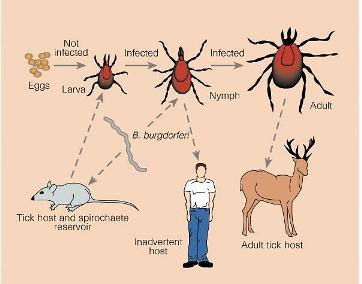
Today's post from fox43.com (see link below) is yet another salutary warning about the dangers of tick bites and how they can cause neuropathy (amongst other significant problems). The problem is that the numbers of neuropathy patients who have contracted it via Lyme disease is growing every year. This is maybe due to increases in tick populations, or an increase in the numbers of people being properly diagnosed but either way the message is clearly not getting through to enough people. By using the search facility to the right of this blog (type in 'lyme disease' or 'ticks'), you will learn more about the problem and about ways to avoid it but if you read this, at least pass on the information to others you know - forewarned is forearmed!
Lewistown mom battles Lyme Disease, thousands show support on social mediaPosted 10:20 PM, May 5, 2015, by Kara Duffy
LEWISTOWN, Pa. — Michelle Wilson knows firsthand just how life changing a single tick bite can be.
“’When I was a kid, you didn’t have to worry about ticks. We rolled down the hill, we played in the woods for hours and now it’s like you’ve got to keep your kid in a bubble; you’re afraid for them to go out and play in the yard because it is life changing,” Wilson said.
Her life changed four years ago. That’s when the mom of two from Lewistown first realized something wasn’t right.
“I was having cold and flu like symptoms,” she said. “I was achy. I had fevers. I had lost some hearing in my left ear. I just kept going back to the same doctors and they were just like, you know, you do not have Lyme Disease; they kept telling me this.”
After more than eight months of unanswered questions, blood work finally confirmed what Wilson says she knew all along: she had Lyme Disease.
“It starts out usually with a simple antibiotic, had I had that in the beginning, you know, when I had asked for it, I wouldn’t be chronic now,” she said.
Wilson says the pain the gotten so bad, she can no longer work.
She’s also racked up nearly $50,000 in medical bills and has had to move back in with her mom just to get by.
“I have neuropathy, which is like pins and needles feeling, burning. I have pain in my muscles, my joints; that’s probably my biggest complaint. I also have neurological and cognitive issues as well.”
Many battle Lyme Disease
Wilson isn’t alone though.
Thousands of people, including celebrities like pop singer Avril Lavigne, are battling the disease every day and now people are turning to social media to show their support, one lime at time.
It’s all part of the Lyme Disease Challenge and here’s how it works:
First, get a lime.
Then take a big bite out of it.
Share a fact about the disease or make a donation to research and finally post your video or picture online, challenging others to do the same.
The challenge couldn’t come at a better time.
A new study by the Department of Environmental Protection shows that deer ticks, the primary carriers of Lyme Disease, have now been found in all 67 counties across the Commonwealth, putting everyone at risk.
“April into May is when we will start to see the cases and typically we start to see the rashes first and then all through the summer,” said Dr. Deborah Riley.
Riley is the Chair of Infection Control and associate Medical Director for Quality at Lancaster General Hospital.
She says the symptoms of Lyme Disease can vary from fever and headaches to muscle aches and joint pain but perhaps the most common sign is a red rash.
“It typically has a bullseye where it has a darker red section in the middle and then an expanding red area,” she said.
Dr. Riley says the best way to prevent the disease is to avoid getting a tick bite in the first place.
“If you are out in the woods or live in a wooded area, do what we call a tick check on a regular basis where you go over your body, your children`s body, your spouse`s body and look for ticks anywhere,” she said.
The Wilson family says, they hope by raising awareness, no other family will have to know the pain of Lyme Disease.
“I worry every day,” said Joyce Wilson, Michelle’s mom. “I see little kids playing in the yard or sitting at ballgames and I just want to go over and yell ‘get up’ because I know what that single little tick bite can do.”
http://fox43.com/2015/05/05/lewistown-mom-battles-lyme-disease-thousands-show-support-on-social-media/
Today's short post (see link below) looks at the current internet trend of tricking readers into thinking you're a serious information-providing site about neuropathy and then hitting you with the hard sell at the end. It's clever and insidious and is part of the advertising pyramid that seeks to take our last cents and convince us that they're doing us a favour by doing it.

27th February 2017 Dave R.
I'm constantly looking for articles with information that may be of benefit to people living with nerve damage (neuropathy) but rejecting those that involve advertising a product or service. There are various 'newspaper' sites and blogs available (like mine) that attempt to do this on a daily basis but because they tend to rely on search bots, they trawl and publish articles that are actually subtly-constructed advertisements. The titles and 70% of the content seem completely convincing and are often helpful in the information they provide but their intentions are a little more devilish than that. Having hooked the readers into believing they're reading a genuine information article about their medical problem, they then launch the hard-sell and promote their own product and/or service. Already convinced, the reader takes the next logical step and reaches for their credit card.
Naturally, the worst are those that suggest they have a 'cure' for neuropathy - believe me, they don't...there is no cure currently for neuropathy! The best we can hope for is temporary relief from the symptoms, so if you see the word 'cure' in their text; treat the article with enormous skepticism because it's Trumpist 'fake news'!
Many commercial sites are extremely subtle in their approach. They have a product and/or treatment that may indeed help alleviate your symptoms. There's nothing wrong with what they say and they are not providing untruths. What they are doing is selling a product or service, to people who are desperate for any form of relief and those people are the most vulnerable to sales patter. If what they offer seems reasonable to you, do your own research to see if you can do it yourself but much cheaper. For instance, many products that claim to improve neuropathy symptoms long term, contain combinations of recognised vitamins, minerals, anti-oxidants, herbs which you can easily buy for yourself at a much cheaper rate. Of course there's convenience in buying something in one 'packet' so to speak (multivitamin tablets are a very successful case in point) but before you shell out your hard-earned cash, make sure you know exactly what you're buying and what it contains or entails. Let the buyer beware! A little research can lighten the load on your wallet (as well as increasing your knowledge base substantially).
The basic message here is: take every promise with a pinch of salt; be hyper critical of what's on offer and armed with as many facts as you can find, make a decision based on what's best for you and not what the advertiser tells you is best. Applies to everything in life doesn't it but we're a vulnerable market. We live daily with sometimes unbearable symptoms and we're 'open' for the next 'best thing' and will seize on exaggerated promises as if they're an oasis in the desert.
Of course there are genuine clinics and practices out there and genuine supplements and alternative therapies and treatments and you may benefit greatly from what they offer but please be a critical consumer - if they want money from you, they're going to exaggerate their claims - it's the name of the game. However, neuropathy patients are used to disappointments and can never say that 'if one thing works for him or her, it's bound to work for me' - it doesn't - neuropathy's too individual and unique to each patient for that, so we have to take responsibility for our own treatment. It's a minefield unfortunately but we need to sort out the wheat from the chaff and reject those who are only interested in emptying our wallets. Desperate patients will clutch at straws (nobody knows that better than the long-term nerve pain sufferer) but we deserve better than to be seduced by sly and clever advertising jargon. It's up to you. If you don't buy into it, it will go away and you'll be doing a service for the rest of the community.Good luckDave R.
This study from John Hopkins Institute researchers is again aimed at diabetes patients (but by now you'll be used to that) and the conclusions suggest that the slow regeneration of blood vessels, cells and axons (single nerve cell extension)is a by-product of diabetes itself. In that case, is regeneration more successful for neuropathy patients with HIV; or even chemo patients with neuropathy?
There are two possible conclusions here: a) that we must never assume that neuropathy is a one size fits all disease and b) that maybe the John Hopkins people just haven't thought about comparing the findings of diabetes patients, to those of HIV patients having undergone the same research!
Either way, this article is written in a way that most of us can understand and shows what's being done to try to repair nerve damage and eventually, that will apply to us all, wherever your neuropathy comes from.
To Fix Diabetic Nerve Damage, Blood Vessels and Support Cells May Be the Real Targets of Treatment
ScienceDaily (June 24, 2011)
Blood vessels and supporting cells appear to be pivotal partners in repairing nerves ravaged by diabetic neuropathy, and nurturing their partnership with nerve cells might make the difference between success and failure in experimental efforts to regrow damaged nerves, Johns Hopkins researchers report in a new study.
About 20 percent of diabetics experience neuropathy, a painful tingling, burning or numbness in the hands and feet that reflects damage to nerves and sometimes leads to infections and amputation of the toes, fingers, hands and feet over time. Current treatments for diabetic neuropathy focus on relieving symptoms, but don't address the root cause by repairing nerve damage. Previous research has shown that nerve cells' long extensions, known as axons, regenerate slowly in diabetics, scuttling various experiments to regrow healthy nerves, explains study leader Michael Polydefkis, M.D., M.H.S., associate professor of neurology at the Johns Hopkins University School of Medicine.
Searching for the reasons behind this slow regeneration, Polydefkis, along with Johns Hopkins assistant professor of neurology Gigi Ebenezer, M.B.B.S., M.D., and their colleagues recruited 10 patients with diabetic neuropathy and 10 healthy people of similar ages and took tiny (3 millimeters) "punch" biopsies from the skin of each participant's thigh. Several months later, they took 4 mm biopsies from the same site to see how the nerves, blood vessels and nerve-supporting cells, called Schwann cells, were growing back into the healing biopsy site.
In both the neuropathy patients and the healthy individuals, results reported in the June issue of Brain showed that the first to grow into the healing skin were blood vessels, followed soon after by Schwann cells and then axons, which appeared to use the blood vessels as scaffolds. However, the entire process was significantly delayed for the neuropathy patients. Not only was axon regeneration slower compared to the healthy patients, as expected, but blood vessel growth rate was also slower, and fewer Schwann cells accompanied the growing axons into the healing skin.
"Our results suggest that regenerative abnormalities associated with diabetes are widespread," Polydefkis says. "They're not just affecting nerves -- they're also affecting blood vessel growth and Schwann cell proliferation."
Additionally, he says, the findings could explain why blood vessel-related problems, such as heart attacks and strokes, often accompany diabetes. Slowed regeneration of damaged blood vessels could contribute to these conditions as well, he explains.
Polydefkis says the findings provide potential new targets for treating neuropathy and vascular problems. By promoting blood vessel and Schwann cell growth, researchers might be able to speed up axon regeneration and successfully repair damaged nerves and blood vessels, potentially combating diabetic neuropathy and vascular complications simultaneously.
Story Source:
The above story is reprinted (with editorial adaptations by ScienceDaily staff) from materials provided by Johns Hopkins Medical Institutions.