Showing posts with label How. Show all posts

Friday, August 18, 2017

Glutes How to Transition From Exercise to Run


You've been told you have weak glutes. Whether it's hip pain, knee pain, ankle pain, it all can be "healed" by improving glute strength. You are prescribed clams, side lying leg lifts, bridges then progressed to squats and lunges. You feel stronger and released to go for a run. Your symptoms feel better but returns after getting back to your routine.

Recruiting Glutes vs. Quads

Is your strength transferring from a basic clam exercise to running? Are your glutes REALLY activating when you run? For most of us, we are very quad dominant. This means we over use our quadriceps when we should be using other muscles such as our glutes. Our sedentary lifestyle of sitting at work or relaxing on the couch has us disengaging our glutes. The quads have at a mechanical advantage to work. Also, the habitual use of quadriceps enhances the neural input from the brain is going to the quads and not the glutes. In other words, the wiring to the quads is better then wiring to the glutes. When running, demand on the muscles is so high we use whatever muscles are the easiest to recruit. The Quads.


I have seen and used different cues such as "stick out your butt"or"squeeze your butt as you stand up". However, most of my patients and clients have a difficulty "feeling the exercise". AND, the improved strength doesn't seem to translate to running.

PUSH YOUR KNEES BACK

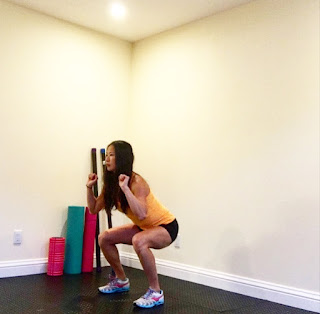
I have been using a different cue to activate the glutes while performing standing exercises such as squats and lunges. While you are performing squats or lunges (or any standing hip exercises i.e. box step ups), pretend like there is an object behind your knee and push back as you stand up. The gluteus maximus is responsible for hip extension, getting your thigh behind you body. However when your foot is fixed on the ground and the knee is given the cue to push back, this extends the knee AND hip. This will engage your gluteus maximus.


Stand up and perform a squat. When you stand up, you feel your thighs press down into the ground and push up. Now try a squat but give the cue for your knees to push back.

FEEL the burn in your glutes.

Now, think of this cue when running. You want to let your knee land normally (with a soft bend), then push back with the knee as your body is moving over your leg. You should feel like your legs are moving in a circle, almost like pedaling a bike. At first, I recommend incorporating this during a warming up, then into sides and finally into your short normal runs. The best way to feel this is up hill sprints!
THIS CUE WORKS BEST IF YOU MIDFOOT OR FOREFOOT STRIKE!

So on top of performing clams, leg lifts and squats add this "push your knee back" cue to the standing exercises.

Please contact me if you have any questions or concerns.

Monday, August 7, 2017

How Long Is A Full Term Pregnancy


Longboard Long Island

Longboard Long Island


Are you full term? Babies born full term have the best chance of being healthy. Find out if you're full term. Learn more..Your pregnancy: 37 weeks. but doctors don't consider your baby "full term" until 39 weeks. with locks from 1/2 inch to 1 1/2 inches long..Pregnancy, also known as gravidity or gestation, is the time during which one or more offspring develops inside a woman. A multiple pregnancy involves more than one .Definition of Term Pregnancy. The work group recommended that the label "term" be replaced by the designations early term, full term, late term, .A full term pregnancy is 37 weeks that's when you are considered 9 months and not your due date. but when you reach your due date which is 40 weeks and .Full-term pregnancy definition changes. Full Term, between 39 weeks and saying it "eliminates confusion about how long an uncomplicated, healthy pregnancy .'Full-term' pregnancy gets a new, narrower definition. Generations of mothers-to-be have heard that babies born any time between weeks of . 'early term,' 'full term,' 'late term,' and 'postterm.' Committee Opinion #579 "Definition of Term Pregnancy .Continued. Term is "a biologic continuum between weeks and those babies born early in term are different than those babies born at full term," he .Typical Pregnancy Now 39 Weeks, tells WebMD there is a concern that at least some of the rise in assisted early who has long stu.d preterm .


Long Sault Ontario

Long Sault Ontario

Photo

Photo


Insulin-dependent diabetes mellitus IDDM is accompanied by long-term microvascular, neurologic, and macrovascular complications. Although the daily management of .TODAY Parents is the premiere destination for parenting news, advice community. Find the latest parenting trends and tips for your kids and family on TODAY.com..


Tuesday, July 25, 2017

How Long Is The First Trimester Of Pregnancy


Longboard Long Island

Longboard Long Island


TODAY Parents is the premiere destination for parenting news, advice community. Find the latest parenting trends and tips for your kids and family on TODAY.com..Taking the pill. The pill comes in the office of a gynecologist or a gynecological clinic. In some cases, the procedure is carried out at home, but .1. What is the Zika virus? 2. How does a mosquito transmit Zika? 3. What areas is Zika likely to reach? 4. Can the Zika virus beually transmitted?.


Longboard Long Island

Longboard Long Island

Pasta Shapes

Pasta Shapes


1. What is the Zika virus? 2. How does a mosquito transmit Zika? 3. What areas is Zika likely to reach? 4. Can the Zika virus beually transmitted?.Taking the pill. The pill comes in the office of a gynecologist or a gynecological clinic. In some cases, the procedure is carried out at home, but .TODAY Parents is the premiere destination for parenting news, advice community. Find the latest parenting trends and tips for your kids and family on TODAY.com..


Tuesday, June 13, 2017

How Soon Do Pregnancy Tests Work


Home Book Club Coming Soon

Home Book Club Coming Soon


Live a healthier life with TODAY's health tips and find the latest news for personal wellness, fitness,t and relationships..


Why Do Fireflies Have To So Soon

Why Do Fireflies Have To So Soon

Facebook Logo Vector Clip Art

Facebook Logo Vector Clip Art


Live a healthier life with TODAY's health tips and find the latest news for personal wellness, fitness,t and relationships..


Wednesday, May 31, 2017

How Do Doctors Prescribe For Pain


Today's post from pain-topics.org (see link below) is, as Dr Leavitt suggests, a very important survey of how doctors prescribe for severe pain. Doctors are only human and have their own prejudices according to their own history and philosophy of medicine. Some feel that pain can be exaggerated, whether consciously or not and it is better to encourage the patient to fight their way through it. Others have little or no experience of neuropathy, so don't really understand the unique nature of its symptoms and others freely give out analgesics up to opioid strength because they see no reason for people to suffer pain in this day and age. One thing is certain, the relationship with your doctor is important if you have neuropathy and if you feel that you're not being taken seriously then it may be worth considering changing doctors. Another interesting point in this article is the fact that 72% of the doctors asked, said that they require their patients to sign a treatment agreement when it came to opioid prescription. As the survey was in the USA, that may be understandable considering the legal ramifications of not doing so but in other parts of the world, it's far less likely that you will need to sign some sort of waiver for your drug use. If you have any opinions as to the value of drug treatment agreements, please let us know by replying via the contact button at the top of the page.


What Do Specialists Prescribe for Pain?
Posted by SB. Leavitt, MA, PhD: Saturday, January 12, 2013

Pain is often managed pharmacologically, but prescribing practices may vary and not always follow established guidelines. An enlightening recent survey of pain medicine specialists in the United States examined their practices and opinions regarding the efficacy, doses, and procedures to monitor the use and safety of commonly prescribed analgesic agents.

For this study, Honorio T. Benzon, MD and colleagues at Northwestern University Feinberg School of Medicine in Chicago mailed surveys to members of 3 U.S. pain-specialty organizations to solicit current expert opinions [Benzon et al.2012]. Three mailings were sent from January 2010 to January 2011 to 2,938 physician members of the American Academy of Pain Medicine (AAPM), the American Pain Society (APS), and the American Society of Regional Anesthesia and Pain Medicine (ASRA).

The survey questionnaire contained 49 questions on topics relating to pharmacotherapy for pain and preferences for using medications in different pain syndromes. A total of 474 physicians responded (16% return), more than two-thirds (69%) were specialists in anesthesiology or physical medicine and rehabilitation, and the majority had more than 6 years’ experience. Here are some highlights of their responses:
72% ask patients to sign a treatment agreement when prescribing opioids; however, only 35% ask patients with alcohol or drug abuse to sign one, while 45% may not use an opioid agreement/contract initially but do so if treatment becomes long-term. A majority, 70%, require a treatment agreement if patients demonstrate aberrant drug-using behaviors (eg, lost prescriptions, frequently running out of medication).

More than half, 59%, order random urine drug testing in patients prescribed opioid analgesics.

69% allow patients to drive once their opioid dose becomes stable and 85% do not think there is a maximum dose of opioids with respect to driving; although, there is no current agreement on this issue, according to Benzon et al.

When prescribing methadone for pain, 43% order baseline ECGs on all patients, while 34% only order the test if there are suspected cardiac problems or in elderly patients. When the methadone dose reaches 50 to 100 mg/day, 36% of respondents convert to another drug, while 43% do not convert at any dose unless there is a clinically evident problem.

About half of respondents (51%) prescribe codeine-containing agents, and most (up to 60%) prescribe this drug for Caucasians and Asians, and 11% for children  up to12 years of age — all of whom may have difficulty properly metabolizing the drug, as noted by Benzon and colleagues.

For treating drug-related constipation a combination of laxative and stool softener was most often preferred (46%), followed by a stool softener (eg, docusate sodium, 20%). Least preferred, by 52% of respondents, was subcutaneous methylnaltrexone, a peripheral opioid receptor antagonist. Bulking agents were favored by 16% and least preferred by 11%, although most guidance recommends against the use of such agents due to risk of bowel obstruction in these cases, Benzon et al. note.

Ondansetron was most preferred, by 51%, for treating opioid-related nausea, while antihistamines (diphenhydramine, meclizine) were least preferred (35%) for this adverse effect.

While 42% of respondents stated that the maximum daily dose of acetaminophen is 3,000 mg, almost all (91%) would caution patients against moderate/heavy alcohol consumption while taking the drug and 75% would decrease the dose in patients who are known moderate to heavy drinkers.

For older persons, two-thirds (66%) of the specialists order acetaminophen as an initial choice of analgesic, followed by COX-2 inhibitors and then NSAIDs (16%, often along with a proton pump inhibitor).

Overall, opioids were most preferred as first-line therapy for cancer pain, while anticonvulsants were preferred for herpetic neuralgia, diabetic peripheral neuropathy, complex regional pain syndrome, radiculitis, spinal cord injury, postamputation pain, and chronic postsurgical pain. Pregabalin was noted as most preferred for fibromyalgia.

Secondarily for the above conditions, respondents noted other drugs or combinations as important, including opioids for noncancer pain, topical lidocaine, duloxetine, milnacipran, and tricyclic antidepressants.

Of the antidepressants, nortriptyline was most preferred (54%), followed by amitriptyline (42%). Roughly half (54%) of respondents do not order an ECG at all when prescribing tricyclic antidepressants, despite increased risks of adverse cardiovascular effects with these drugs, as noted by Benzon and colleagues.

The survey found that 62% of respondents would decrease the dose of tramadol in patients taking SSRI, SNRI, and MAOI antidepressants to avoid possible serotonin toxicity; however, more than a third of respondents might not have been aware of this serious interaction, Benzon et al. suggest.

The most preferred musculoskeletal relaxants were tizanidine or cyclobenzaprine (each named by 26% of respondents), followed by baclofen (19%) and metaxalone (16%). Only 4% chose carisoprodol as being most preferred, while 41% chose this as least preferred.

The information above reflects practices and opinions of survey respondents and are not suggested as recommended or approved medical practices. Benzon and colleagues conclude from their survey that the responses pertaining to opioid agreements, urine drug testing, acetaminophen dosing, and treatments for neuropathic pain are reassuring in that they help to prevent misuse and abuse of opioids, control acetaminophen-induced hepatotoxicity, and reflect evidence-based treatments. However, they express concerns about identified gaps in knowledge, including the prescription of codeine in certain populations and the disuse of ECGs in patients on antidepressants. They stress that further education of physicians who treat chronic pain pharmacologically is warranted.

COMMENTARY: This was an important survey and the journal article contains much more detailed information than space above allowed; so, readers may want to acquire the full text [see link in reference below, subscription or purchase required]. A major strength of this survey was that, while other researchers have examined attitudes and practices relating to opioids, this current investigation was an open-ended consideration of all drugs commonly used in pain management.

However, the exploration was limited primarily to cancer, neuropathic, and fibromyalgia pain syndromes. This is unfortunate, but a more extensive survey covering additional pain conditions might have made the questionnaire forboding to recipients. As it is, another limitation of the study was that the response rate was relatively low (16%) among the total sampling of pain specialists mailed surveys.

There is no way of knowing if survey results reflect the knowledge and practices of the best-of-the-best practitioners in the pain field, or from a broader cross-section of specialists who merely had extra time available to answer questions. Some knowledgeable readers may disagree with the opinions and practices of survey respondents.

More studies of this nature seem essential, particularly because of the knowledge gaps and certain debatable practices identified. And, one might suspect — as Benzon et al. allude to at the end of their article — that the pain management knowledge and practices among nonspecialist healthcare providers might be even more deficient.

NOTE: Various documents at Pain-Topics.org discuss pharmacotherapy for different pain conditions, with many addressing educational gaps identified by the above survey. Go to pain-topics.org/opioid_rx for documents focusing on opioid therapy, and pain-topics.org/pain-disorders for papers on select pain disorders. Look for the “PT” icon, which denotes papers we have created especially to fill important knowledge gaps.

REFERENCE: Benzon HT, Kendall MC, Katz JA, et al. Prescription Patterns of Pain Medicine Physicians. Pain Practice. 2012; online ahead of print [abstract here].

http://updates.pain-topics.org/2013/01/what-do-specialists-prescribe-for-pain.html
Tuesday, May 30, 2017

How To Avoid Being The Neuropathy Grinch At Christmas


Today's short post from nationalpainreport.com (see link below) is about as current a topic as you can get and talks about dealing with chronic pain and other neuropathic symptoms when everyone around you is hollering and whooping with (enforced) joy. You often just want them to go away and leave you alone, curled up in a ball in a Harry Potter cupboard under the stairs. Not a good idea if you want sympathy from your nearest and dearest for the rest of the year! However, your problems are all too frequently underestimated and ignored and that can double their effect. This article gives a pretty skimpy and clichéd set of advisory tips but in the end, you have to face the problem and develop your own strategies to survive the holiday period. That doesn't mean giving in to all demands and wearing your plastic smile until the twelfth day of Christmas but it does mean setting boundaries for yourself and getting your alone time if and when you need it. A bit of explanatory preparation will help others to understand you're not going to be 'on' all the time. look after yourself first but helping others enjoy themselves is a positive distraction from your daily pain.

The Christmas Holidays and Chronic Pain
Posted on December 24, 2015 

The holidays are a joyous time for many – but for others, including many who suffer from chronic illness, it can be a difficult time. What the head of the Southern Pain Society calls the “Holiday Blues” or the “Charlie Brown Christmas” may occur at any holiday or vacation time, but most commonly happens during the December holidays.

We asked one of our contributors, Dr. Geralyn Datz about the difficulty that some people have in the holiday season. She says the sadness and even depression can come on for a variety of reasons, like high physical stress as well as psychological and financial and family tension. Dr. Datz is a licensed clinical psychologist who specializes in behavioral medicine.

For some pain patients, it can be caused by both the memories of what life was like when you were pain free and/or because, well, the pain just hurts.

What helps manage it?

The answers are not surprising but often for pain patients, they just aren’t easy to do:


Rest and Get Enough Sleep
Regular Exercise
Eat a balanced/healthy diet

Dr. Datz talks about coping…and has some tips on what to do.
Surround yourself with supportive people—reconnect with old friends
Talk with family about the limitations your pain imposes, “Be honest with yourself and with your family about what you can and cannot do,” she said.
If you are religious, “focusing on the spiritual significant of the holidays can also help.”

Dr. Datz leads the Southern Pain Society which was incorporated in 1989 and is a region of the American Pain Society covering the 18 southern states and Puerto Rico.

“Our mission is to serve people with pain by advancing research and treatment and to increase the knowledge and skill of the regional professional community,” she said.

The Christmas holidays aren’t easy for the chronic pain patient.


In our commentary section to this article tells us how you are doing during the holidays and what you do to cope. We’ll take some of the comments and share them in a story on Christmas Day.

Your friends at the National Pain Report wish you a Merry Christmas and happy holiday season, and know that we are thinking about you.

http://nationalpainreport.com/the-christmas-holidays-and-chronic-pain-8828839.html

Wednesday, May 10, 2017

How Important Is Vitamin E To Nerve Health


Today's post from neuropathydr.com (see link below) is another useful and easy to understand article from the ever-reliable, Dr John Hayes jr. He explains the benefits of vitamin E to nervous system health and quite rightly warns against over-use, which can be harmful. It is important to state here that supplementing with vitamin E alone will not help your neuropathy on its own. It's a question of finding the right balance and package of supplements for you and that can be determined by vitamin and mineral level tests carried out by your doctor. These will highlight deficiencies you may have and help you decide where you need to take extras. It's also wise to look at the amounts of various vitamins and minerals that are contained in your daily multi-vitamin pills (a good idea anyway) and bear in mind that whatever you take extra, may push you over the best daily amounts for you. It's very easy to over use supplements, which may lead to health problems and will certainly lead to wallet problems! Dr Hayes also wisely points out that improvements don't happen overnight - you need to take these supplements for some months before you may notice any benefits. Many people give up after a few weeks when they fail to see any improvements.

Vitamin E and Nerve Health
Posted by john on January 9, 2014
 

With neuropathy, if you lack vitamin E, it will be impossible for your nerves to heal and function properly.

Vitamin E is an essential nutrient for all of us, especially those who suffer from many forms of peripheral neuropathy.

As a member of the fat-soluble vitamin family that includes vitamins A, D, E and K, it is also lacking in many modern diets.

This is also one key nutrient that occurs in eight different forms; two are the most biologically active. The most common are gamma and alpha. In your diet this will be found primarily in nuts, seeds, and vegetable oils.

Vitamin E is an antioxidant, which basically means it helps prevent cells from damage due to “free radicals”, or cell destruction generated by some biochemical reactions.

Although Vitamin E is best known for its role as an antioxidant, it does have some profound roles in protecting the nervous system. Vitamin E is essential to helping healthy nerve function, as it helps us repair and protect myelin, the sheath that insulates our large nerves.

Healthy myelin is largely responsible for normal nerve conduction.

In fact, studies suggest that Vitamin E, when given to diabetics can improve nerve conduction significantly1.

But there are some precautions: First, there are no overnight miracles. Supplementation for months may be necessary to see a significant effect. Too much Vitamin E can cause the blood to thin; this has an additive effect for anyone who takes Coumadin and other anticoagulant medications, including aspirin. Be especially careful here!

In addition to seeds and nuts (almonds and sunflower in particular), there are some other good dietary sources of Vitamin E, such as palm oil, the principal ingredient in “Earth Balance”, a butter substitute and line of products we recommend. To a lesser extent, leafy green vegetables and avocadoes will provide some active vitamin E.

Generally, safe supplementation is in the range of 2 to 400 international units of mixed tocopherols for most patients.

There maybe other occasions where your physician may want to prescribe larger amounts of the d-alpha tocopherol form. This is sometimes done in other neurologic conditions including multiple sclerosis.

As we say all the time, there is no one single magic nutrient. But if you lack vitamin E, it will be impossible for your nerves to heal and function properly.

This is another reason why multiple nutrient components are necessary for effective health maintenance and treatment of disease; this is not a short-term proposition.

As always, with neuropathy it is important to work very carefully with your physicians and therapists and make sure that your progress is monitored.

1. 10.2337/diacare.21.11.1915 Diabetes Care November 1998 vol. 21 no. 11 1915-1918

Dietary antioxidant interventions in type 2 diabetes patients: a meta-analysis The British Journal of Diabetes & Vascular Disease March 1, 2011 11:62-68

http://neuropathydr.com/vitamin-e-and-nerve-health/

Tuesday, May 9, 2017

How Do You Describe Your Neuropathy Self


Today's post from paincommunity.org (see link below) is a sort of self-help article, the like of which many neuropathy patients are used to and generally find that 'it's easy for them to say!' However, there are some good points here and it does show how easy it is to talk yourself into feeling worse than you actually do by your choice of words. When you describe your symptoms to your doctor, or others, do you immediately go for the worst case scenario and use language to try to convince the listener that you're not faking it? It may be perfectly understandable (we face enough disbelief and incomprehension as it is) but you may not be doing yourself any favours because you may end up believing your own descriptive language. Talking your pain and discomfort down a bit may help to reduce the impact psychologically. After all, what you're feeling is bad enough without exaggeration of any sort. Certainly something to think about.


The Words You Choose Make a Difference  
Posted by Dionetta Hudzinski | July 16, 2014

Words are the building blocks of language. We use words to communicate our thoughts, ideas, beliefs and emotions. Words can have specific meaning or a variety of meanings depending how they are used in conversation. Words can convey a clear message or a confusing message. Some words are gentle and comforting while others are harsh and distressing to hear. It is HOW we use words that matters most.

Words can explain, define, label, clarify or confuse. Words can influence (positively or negatively) our beliefs about us and our beliefs about others. Words can influence how we think; how we think can influence how we feel.

So what does this have to do with pain management, you might ask? Lots! First our self-talk and the words that we use can either build us up or tear us down. I know, I was the worst offender in this area. The words I chose to speak to myself were harsh, condemning and not nice at all. I would never use those same words to talk to friends or family but I was using them on myself. Words like lazy, worthless, failure, you’re not enough, you’ll never succeed at that…these and so many others; no wonder I was feeling less than everyone else, feeling like a failure with no motivation to change. Why change? My self-talk told me it was not even worth starting so why bother? At one of my lowest points I decided to take an online course which changed my life…in fact the course was called “Change Your Life In 30 Days” with Rhonda Britten famous TV Life coach of the Starting Over TV reality show. I learned that words carry energy and that I need to choose my words carefully and wisely. Slowly over 30 days I stopped the negative self-talk and replaced it with positive thoughts. I learned how to be gentle with myself and how to practice self-compassion. In fact, I came up with a little affirmation that I say even today when a negative thought pops up…”I forgive myself for having that thought; I choose love instead”. My overall vocabulary changed and with it my attitude and motivation.

Vocabulary matters! Think of words that people use to describe people in pain. Words that make you cringe when you read the latest news article about prescription drug abuse. Words like – narcotic, addict, doctor shopper, pain victim and pain killer- are coated heavily with negativity and prejudice. Words that ought to be used are opioid, substance use disorder, pain relief seeker, person living with pain or pain medication.

For example, the word narcotic is a legal term used to denote illegal drugs such as heroin and cocaine. When used in that context, it is appropriate and clearly states what the issue is at hand. When used in the health care system, it unjustly labels individuals who need to take a class of medication called opioid analgesics. The term “addict” is derogatory in nature, whether referring to someone who is physically dependant on opioids treating their pain as well as when referring to someone with a substance use disorder. Addict inappropriately labels someone to a lower station in life as if they are of lower value as a human being.

Even the word DRUG can carry with it a negative overtone—drug as in street drugs? People with pain take medications not DRUGS. What about if you find yourself calling your Oxycodone “OXY’s”? Oxycodone is the medication and OXY, is a street name. How about choosing to call Percocet (oxycodone with Acetaminophen) “PERCS” which is again, a street name? How does that label you and others who use these medications for the legitimate treatment of pain? How do you feel when you hear those words used when directed at you?

How do the words “drug seeking” strike you? Wouldn’t you rather hear relief seeking? How about being called fat or obese compared with over-weight? How about crippled vs disabled, impaired or handicapped? I looked up the word disabled – other words with similar meanings are incapacitated, inactivated, deactivated, Immobilized, hindered, or rendered useless. Words are powerful in defining ourselves. Think about how you feel when you read “pain sufferer” vs. a person experiencing or living with pain? One is powerless and helpless while the other is empowering and uplifting. After all, not all people living with pain are pain sufferers especially when they have secured an effective pain treatment plan. Many thrive and show their strength in character every single day. What about the use of the word “victim” compared to survivor—one shows helplessness and the other strength? Which would you prefer?

Words are energy. A Japanese researcher, Dr. Masaru Emoto, who wrote Hidden Messages In Water, says that water and its crystals are influenced by the environment they are in. He has shown through his unique photographic process how certain words shaped beautifully awesome crystals while other words produced ugly and unorganized crystals. Words like “I love you. You are beautiful” form gorgeous well organized crystals while words like “I hate you. You are ugly” form distressing unorganized forms that make you turn away. We are composed of 70% water so what do words do to our water?

Another aspect to consider is that your brain believes what you tell it…and makes no distinction between whether it is a true statement or not. So what words do you use to talk to yourself and others?

Choose wisely. I choose love, gentleness, compassion and patience.

Posted in Communication

http://paincommunity.org/words-choose-make-difference/

Monday, May 1, 2017

How Regular Routines Will Help With Neuropathy


Today's short but useful post from dressamed.com (see link below) comes via other sites, from Dr. John Hayes Jr, whose work on neuropathy is always directed towards the patient and easy to understand. It talks about the importance of sticking to 'good habits and schedules' in your daily life, or at least as much as possible. People who have good routines regarding eating, exercise and treatment often do much better when it comes to neuropathy, if only because the nervous system can better deal with problems if the patient's daily life has some sort of regularity or order to it. An interesting post that makes you examine your own life to see if there's room for improvement.

Habits and Routines: Powerful Neuropathy Treatment Weapons 
Posted on May 11, 2016 Posted in Staff Pick by Staff Pick

Effective neuropathy treatment plans are easier to implement with patients who are able to keep good habits and schedules.

It is a well-known fact that our daily habits contribute more to our long-term well being than any other single activity.

What does your daily routine consist of? Are you naturally active, or does it become a challenge for you to motivate yourself? Do you make extra effort to walk more when you park your car to go shopping, for example? How about when performing household or yard tasks?

Our daily habits that affect ourselves includes things like aerobic exercise, drinking soda, tobacco usage, excessive over the counter drug usage, et cetera.

It also includes our mental activity; we have the choice to regularly have active mental stimulation such as reading and meditation, versus passive activities such as long periods of watching television.

Unfortunately, most of us never take a hard look at our daily activities, and the impact they’re having upon our health.

Now, when you’re young, these are relatively easy to ignore. But throw in advancing age, and some health challenges, and it becomes a different ballgame!

With chronic pain and neuropathy, sticking to good daily health habits becomes a much more difficult task.

But, what I can tell you after taking care of hundreds of patients is that those who have routines and habits fair far better! Both in terms of physical capacity to enjoy life, and their mental outlook!

One of the reasons for this is more effective neuropathy treatment plans are easier to implement with patients who have good habits and schedules.

You can start right now by developing then sticking to a daily routine of your own design! Scheduling and timing of daily things such as meals, light activity, supplements, and even your own self-care goes along way.

One of the reasons this is true is your body has its own biorhythms.

Timing of certain supplements, and even self-treatment throughout the day can make a BIG difference in your outcome!

And these are all things your neuropathy treatment specialist is able to assist you with.

Just make sure you engage us and ask for guidance with regard to the most effective neuropathy and chronic pain treatments and activities.

But most importantly ask and learn about the best scheduling, and timing.

Make a DAILY schedule for yourself, and then stick to it! You’ll be very glad you did!

About The Author


Dr. John Hayes, Jr. is an Evvy Award Nominee and author of “Living and Practicing by Design” and “Beating Neuropathy-Taking Misery to Miracles in Just 5 Weeks!” His work on peripheral neuropathy and chronic pain has expanded the specialty of effective neuropathy treatments to physicians, physical therapists and nurses. Do you have a powerful daily routine? Join our conversation today on BeatingNeuropathy. To book interviews and speaking engagements with Dr John Hayes Jr call 781-754-0599.

Syndicated by EzineArticles

https://www.dressamed.com/root/habits-and-routines-powerful-neuropathy-treatment-weapons/

Tuesday, April 18, 2017

How To Deal With Entrapment Compression Neuropathies


Today's post from drducicplasticsurgery.com (see link below) looks at neuropathy from the point of view of a surgeon and in this case, a plastic surgeon. As you all know, there's no cure per se for neuropathy but certain forms may be relieved by surgery of one form or another. These are compression neuropathies (sometimes called entrapment neuropathies) which are caused by a nerve becoming trapped. This can be because a disease causes the nerve pathways to narrow, or it can be as a result of injury. Either way, releasing the trapped nerve may result in a huge improvement in symptoms, although there are no guarantees, depending on the damage to the nerve itself. Worth a read.

Compression Neuropathies in Extremities
03 Aug 2016 Compression Neuropathies in Extremities


The many types of neuropathies are a series of complex conditions that can take many forms and be caused by many different things depending on the type of neuropathy that is diagnosed. Understanding what your specific neuropathy is and what the symptoms are is the first step in taking control of your condition.


What are Neuropathies?

This term describes a problem with the nerves (typically the peripheral nerves) and it could involve one of three nerve types. These three different nerves include:


Sensory Nerves – an issue with these nerves causes tingling, pain, numbness, and weakness in the hands and feet
Motor Nerves – issues with these nerves causes weakness in the hands and feet
Autonomic Nerves – a problem with these nerves causes changes in the heart rate and blood pressure as well as swelling

There are two major types of neuropathies and knowing this information can help determine the severity of the issue you are currently suffering from. These two types include mononeuropathy and it affects a single nerve. The other is called polyneuropathy and affects several different nerves.

When studying the specific forms of neuropathies, a common form is called compression neuropathy. This is caused by damage to sensory nerve roots or even peripheral nerves and could potentially have many different causes.


What are Common Causes and Symptoms?

Compression neuropathy is caused by mechanical pressure or occasionally localized trauma from an injury to a specific area. This form of neuropathy is normally characterized by paresthesia, weakness or even paralysis. This will depend on what specific form of neuropathy you may have.

Diabetes and pre-diabetes are the most common causes of compression neuropathy although they are not the only causes. This being the most common cause is because with diabetes the nerves are swollen and when these nerves run through certain tight channels within the body, they become compressed. This causes the resulting pain and numbness.


Treatment Options

The most popular form of treatment is surgery although there may be other options for your form of compression neuropathy. The decompression surgery relieves the compression on the nerves and can reduce or completely eliminate pain, improve sensation, improve balance and also prevent ulcerations or amputations. This form of surgery has great results and it is estimated that about 80% of diabetic and pre-diabetic patients have some success from receiving this surgery.

Checking for other conditions is very important because some forms of compression neuropathy have causes that can be treated without the need for surgery. For example, if the issue is a thyroid based problem, other treatment options may be a possibility.


Common Forms of Compression Neuropathies

There are many forms of compression neuropathies that are common and well known. 

 
Carpal Tunnel Syndrome 


caused by compression of a nerve in the wrist
Involves numbness in the first three fingers. 


Cubital Tunnel Syndrome


caused by compression of ulnar nerve at elbow
Numbness in 4th and 5th fingers, hand weakness


Radial Nerve Neuropathy


compression of radial nerve in forearm or upper arm
Often follows humeral fractures and surgery
Forearm pain, weak wrist dorsiflexion or finger extension 


Tarsal Tunnel Syndrome


caused by compression of the tibial nerve in the ankle
also called posterior tibial neuralgia


Meralgia Paresthetica (LFCN Neuropathy) 


caused by compression of a nerve in the thigh area
may follow surgery in groin/hip area, professions caring belts around waist, like police officers, fire fighters, contractors 


Foot Drop 


most often caused by an injury to the peroneal nerve
there are options for treatment beyond surgery although surgery is an option that can be considered

Compression neuropathies include many different forms and have just as many causes. Understanding the proper form of treatment begins with first understanding what the cause was. While diabetes and pre-diabetes are often causes, there may have been trauma from a sports injury or another disease that is the root issue. Having all of this information may help you and your healthcare provider decide whether or not surgery is the best choice for your individual condition.

https://drducicplasticsurgery.com/compression-neuropathies-in-extremities/